


Normandy Battlefields Trip for 2403 Aldermaston Air Cadets
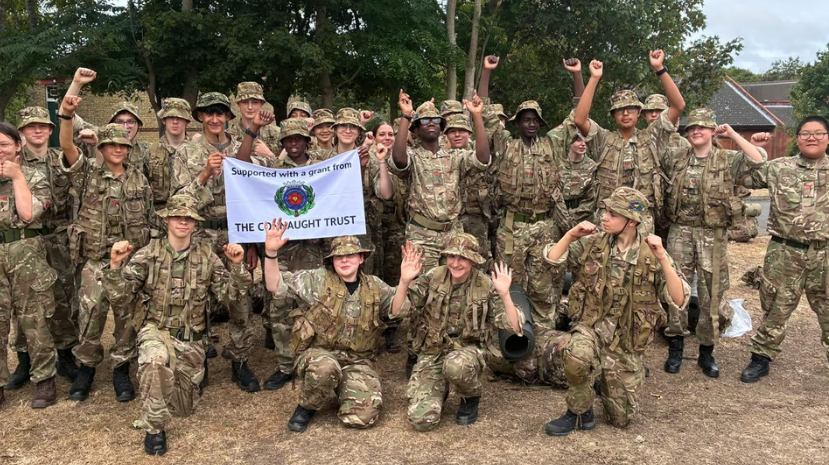
With the assistance of the generous help from The Connaught Trust, 2025 marked the first trip abroad for the Air Cadets of 2403 (Aldermaston) Squadron.
It had been a dream for some time, to take our Cadets to the Normandy Battlefield, and witness firsthand the sights, exhibitions and memorials relating to D Day. We wanted to expand their understanding of the events of that day, why is was so important to WW2, and to appreciate the sacrifice made by so many brave service men and women.
We started our tour in Arromanches, the site of the incredible Mulberry Harbour. Thanks to the grant we received, in addition to what you can learn from information points around the town, we were able to visit a 360-degree cinema experience, as well as the museum in Arromanches. These really brought the event to life, showing period recordings for life of civilians in occupied France, and the hardships they faced amongst the devastation of their town. It talked about the leadership of Charles de Gaulle, defiant in the face of opposition, capitalising on the spirit of the French people, with the assistance of the UK and USA, to repel the German invaders from their land,
Our Cadets learned about the innovation that war tends to encourage, and the engineering marvel that was the Mulberry Harbour. They learnt about its conception, development and deployment to Gold Beach. And most importantly, the tactical advantage it gave the Allies to support their troops.
We visited Omaha Beach, and the Cadets were each given a number, stood at the water line. They were instructed to run forwards, up the beach, stopping when they heard their number shouted. Before they even set off, half of them had their number called. As the rest surged forward, nearly all the numbers were shouted out, leaving barely any to reach the rocks.
This was a graphic demonstration to show just how few of those first brave souls made it from the landing craft to a fighting position. It was very impactful for the Cadets to better understand what forces were up against in 1944.
We went on to visit the American Cemetery, and the British on a Bayeux. We had recently had a talk from the Commonwealth War Graves Commission, in order that the Cadets better understood the different types of headstones, and their arrangement (for example a pair indicated crew of a Lancaster bomber that were lost, brothers in arms). Some of the Cadets chose to write a message on a small cross and leave it at a headstone that meant something to them.
We visited the amazing British Normandy Memorial at Ver-sur-Mer, where the many stone pillars are inscribed with the names of 22,442 men and women who fell during D Day and the Battle of Normandy. Due to last minute rules set out by the MOD, it had been forbidden to allow Cadets to carry out the whole tour dressed in anything that marked them out as being part of a military organisation. So, whilst at the British Memorial, the Cadets were excited to proudly don their polo shirts commissioned specifically for the trip, complete with the ATC and Connaught Trust logos, to attend a short ceremony by our own Padre, and lay a wreath of remembrance, as a mark of respect and gratitude.
Our final destination before heading home was Pegasus Bridge, a site of huge tactical importance, and where the first troops landed via the HORSA gliders at 00:16, 00:17 and 00:18 on June 6th, 1944, with staggering precision given the poor weather and pitch black conditions.
The Connaught Trust grant had again helped us to organise the extra luxury of a private guided tour of the museum, and the bridge itself. The Cadets enjoyed being able to stand on an exhibit of such historical importance. Our guide was excellent, and really engaged the attention of our Cadets, bringing the story to life for them.
Upon returning to Squadron, we asked the Cadets to complete an anonymous survey, to gather the most honest feedback possible about the trip. Without exception, they all confirmed that this trip had expanded their understanding of the events in Normandy, helped them to understand just how many different things had come together, just when they needed to, to make it happen. They were taken aback by the scale of the cemeteries, and the poignant Standing with Giants art installation that represents the 1475 service personnel that lost their lives under British command, on 6th June 1944.
We are hugely grateful to The Connaught Trust for their support in this project and the opportunity it gave us to help another generation remember what others gave for them. We look forward to planning our next trip and continuing their education.
APPLY FOR A GRANT FOR YOUR UNIT


Comments